Sunday, January 11, 2015

Genetic Engineering Could Save Crops From Pests

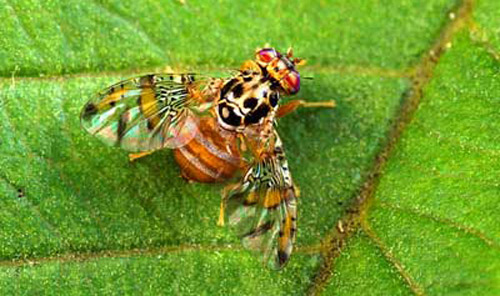
Mediterranean fruit fly

The Mediterranean fruit fly is a serious agricultural pest which causes extensive damage to crops, but New research reveals how the release of genetically engineered male flies could be used as an effective population suppression method.

These genetically engineered flies are not sterile, but they are only capable of producing male offspring.

Researchers at the University of East Anglia and Oxitec Ltd. simulated a wild environment within secure eight-meter greenhouses containing lemon trees to study the impact of releasing Oxitec flies."We found that they were capable of producing rapid population collapse in our closed system," says Lead researcher Dr Philip Leftwich.

“This method presents a cheap and effective alternative to irradiation. We believe this is a promising new tool to deal with insects which is both environmentally friendly and effective.”

Another method of pest control is the use of pheromones to attract or repel crops, but rather than relying on industrial labs to synthesize pheromones, researchers have genetically engineered plants to do such work for them.
Tobacco plant

Plant biologists report on genetically engineered tobacco plants that produce a pheromone that once extracted from the plant, can be used to trap male moths. If scientists were to engineer plants to produce other pheromones, it would result in the trapping of other pests that endanger crops.

According to Steve Seybold of the US Department of Agriculture Forest Service’s Pacific Southwest Research Station in Davis, California, "It will change the way that commercial pheromone outfits do business." 

Pheromone producing plants will not only increase the quality and lower the price of commercial pheromone products,but also reduce the use of harmful chemicals in pheromone production. 

Genetically Engineered Mice Could Help Prevent Illnesses Associated with Aging

Age related illnesses result from mutations accumulated by our DNA as we age.  Recently, biologists from the University of Rochester have discovered that one of the reasons that DNA is damaged is because the repair process begins to fail as animals age. As we age, DNA is replaced with a copy that is less accurate.

"Scientists have had limited tools to accurately study how DNA repair changes with age," said Gorbunova, but she and her team were able to observe the DNA repair process by working with genetically-modified mice whose cells produce green fluorescent protein that glows each time the breaks are repaired.

Through their observations, the team discovered that when mice are young, the breaks in DNA strands are repaired through a process called non-homologous end joining, but as they age this process begins to fail. This failure allows a less reliable DNA repair process known as microhomology-mediated end joining to take place: this process leads to loss of DNA segments and the wrong pieces being stitched together.

By studying these mice, Gorbunova and her team aim to discover new ways to prevent illnesses associated with aging.

Sunday, January 4, 2015

Tracking Pollutants in the Body

Charles Tyler  and his group of scientists have genetically modified zebrafish that glow green to help illuminate what pollutants do inside the body.


Tyler and his team of scientists exposed the zebrafish to varying levels of endocrine disruptors (chemicals known to affect the hormone estrogen) including nonylphenol which is present in paints and industrial detergents and bisphenol A which is a component of many plastics.

These substances have become common freshwater pollutants that are connected to various reproductive problems in both people and animals. Previous research has shown that by mimicking the actions of sexual hormones, the chemicals cause fish to change gender, and in people, endocrine disruptors have been associated with lower sperm counts and breast and testicular cancers.

Yet scientists have had difficulty tracking what endocrine disruptors do inside a person or an animal's body. So Tyler and his colleagues genetically engineered zebrafish to glow where an endocrine-disrupting chemical is present, and therefore show where it may be harming the body.

The researchers exposed the fish to different endrocrine disruptors at varying concentrations, and then used a microscope to see which of the fish's organs glowed, and thus responded to the chemicals.

The data should help identify to what extent the chemicals affect various tissues and organs in the body.

Although it's been thought that these chemicals only impact the liver, testes, or ovaries, the chemicals also illuminated other parts of the fish's anatomy, including its eyes, skeletal muscles, and parts of the brain.  However,  the impact of endocrine disruptors to these parts of the body are unknown.

For now, the observation of fluorescent technology is limited to fish younger than six days old, because after that their skin develops pigmentation that interferes with viewing the fluorescence.

In the future, Tyler hopes to breed the zebrafish with a strain that lacks pigment in the skin which would allow the team to observe the fluorescent reactions in adult fish as well.


Because the article did not provide a link to the research findings of Tyler and his team, I am still left with multiple questions:
What evidence is there that supports the author's claim that endocrine disruptors have been associated with lower sperm counts and breast and testicular cancers?
Although this experiment was a great start for studying the effects of pollutants, will future models for this experiment include test subjects that are more similar to humans?
How do the pollutants enter the bodies of the fish? (Are they ingested, are they absorbed through the skin, etc?)
Does the mode in which the pollutant enters the body change it's affects on certain organs and tissues? (For example, do the affects of the pollutant vary depending on whether it is ingested or if it is inhaled?)
Do pollutants enter the body of a fish and the body of a human using different modes? (For example, fish absorb the pollutants through their skin while humans ingest the pollutants.)
If the two previous questions were found to be true, would the validity of the experiment in this article be compromised seeing as the affects of the endocrine disruptors might be too different on each organism to predict any correlation between the data collected from the zebrafish and possible affects on humans.

Sunday, December 14, 2014

A Modest Proposal

There is a trite scene that awaits those who travel through these school hallways; it is replete with students who physically and emotionally abuse one another, and the air is filled with the sound of hurtful words ridden with scorn and sometimes shouting can be heard resulting from a physical skirmish here or there. For those victims who make it past graduation without succumbing to damnation first, they enter a life of psychological trauma that is almost irreversible at least not without extensive and expensive treatment. As for the abusers? They will most likely go on abusing anyone they please; this could take the form of the harassment of coworkers, or perhaps the physical and emotional abuse of a significant other and their future child.
            
My intention is to benefit the lives of everyone who is bullied for being different: it’s not just confined to little Jimmy in biology who is a little quirky, but instead it extends to everyone spanning from across the globe composed of varying races and cultures who experiences prejudice.
            
I have been assured by scientists that the field of genetic engineering has a simple solution to this problem that could be available within only a few decades; therefore, I offer it to the public to take into consideration genetically engineered babies. I have been told that it’s a rather elementary process, almost primitive if I should be so bold to add: just deleting a DNA sequence here and adding a new one there, so why stop at designer dog breeds when the possibility of designer children exists?
            
By changing the look of people before they are even born, scientists can guarantee that everyone looks identical, and if everyone looks the same, then no one would be bullied for being different. Obviously people can be different in other ways besides appearance, but soon enough genetic engineers will be able to manipulate traits such as athleticism, artistic capabilities, and intellectual prowess, so everyone will be alike in every respect. No one shall ever again be bullied for being too smart or too dull, too tall or too short, too feeble or too feeble-minded.
            
I realize that this technology will not be available to everyone as a result of financial insecurity, but not to worry: only about 30% of the world population is below the poverty line which means that only 2,100,000,000 people will not have access to designer babies. As for the rest of the 4,900,000,000 humans who will produce genetically engineered children, according to my calculations in as little as seven generations they will breed out any of the non-desirable traits from the gene pool by reproducing with non-designer humans and passing on designer traits to those offspring via their genetically modified DNA.
            
I hope my proposal will not be liable to the least objection, but I do not favor my own opinion so much that I would reject any offer proposed by wise persons, which are found to be equally innocent, cheap, easy, and effectual, but since something of that kind has not been advanced in contradiction to my scheme, which, as it is wholly new, so it has something solid and real, of no expense and little trouble, let no man talk to me of other expedients: Of raising awareness to the general public of what atrocities are being committed against their children: Of creating better organizational support as a means for students and employees to seek refuge or report abuse. Lastly, of normalizing diversity so that instead of feeling hatred towards anything that is different, it becomes just a normal part of everyday life.

            
I announce, with deepest sincerity, that I have no personal gains to be made by promoting this motion. As I have said before, this technology will not be available for decades; in which time I will be far beyond my child bearing years, so I would not be able to produce any genetically engineered children. 

Thursday, December 4, 2014

Gene Network Associated with Alcoholism


This article states that scientists at the University of Texas have identified a network of genes that work together in determining alcohol dependence. These findings could lead to future treatments for alcoholics and allow doctors to screen for alcoholism.

Even though genetics play a role in alcoholism and addiction, the tendency for dependence to be genetically linked is more complicated than the presence or absence of any one gene. However, this study is the first time that scientists were able to use RNA sequencing to identify a specific group of genes that, expressed together, are highly correlated with alcohol dependence.

The identification of genetic factors and networks in the brains of alcoholics gives drug researchers more information to work from and may one day allow for better screenings to evaluate a person's risk for alcohol dependence, even before the onset of heavy drinking.

Wednesday, December 3, 2014

Possible New Treatment for HIV/AIDS

An article published on November 7, 2014 states that scientists at Harvard Stem Cell Institute have used a gene editing method to create what could be an effective technique for blocking HIV from invading and destroying patients' immune systems.

HIV enters T cells through the gene receptor CCR5, and once it is inside the T cell, HIV replicates and kills off the host cells, leaving patients at the risk of infection.


Using the CRISPR/Cas gene editing technology, the scientists removed the CCR5 receptor from blood stem cells that could produce blood cells that did not have CCR5.

In theory, gene edited stem cells could be introduced into HIV patients through a bone marrow transplant to make immune systems HIV-resistant, and the researchers believe this new approach to HIV therapy might be ready for human safety trials in less than five years.

However, even if this new approach works perfectly, it will require additional developments to be applicable in the areas of the world that have been the hardest hit by the epidemic.

For instance, 26% of the adult population in Swaziland is affected by AIDS. Swaziland has been marred by political and civil unrest. As a result health services are poorly equipped, so even if this new technology is commercialized it is unlikely that it will be available in the countries that need it the most.

Monday, November 24, 2014

Satirical Cartoon Analysis


This cartoon illustrated by Chris Kelly demonstrates the power that companies responsible for genetically engineered products have over the public, and the lack of their transparency.

Kelley conveys the immense power that these businesses have over the people by depicting them much larger that the consumer.

The cartoonist expresses the lack of transparency of biotechnology corporations by only showing the legs of the personification of GMO creators. By omitting their face, the industry is unrecognizable and remains anonymous. Since consumers do not know who is producing their food, they can not trust them.

The cartoon above by Chris Kelly was published 15 years ago, and in that time nothing has changed. Corporations are still not required to label if their foods are genetically modified. This is a problem because I firmly believe that consumers have the right to know what they're ingesting.